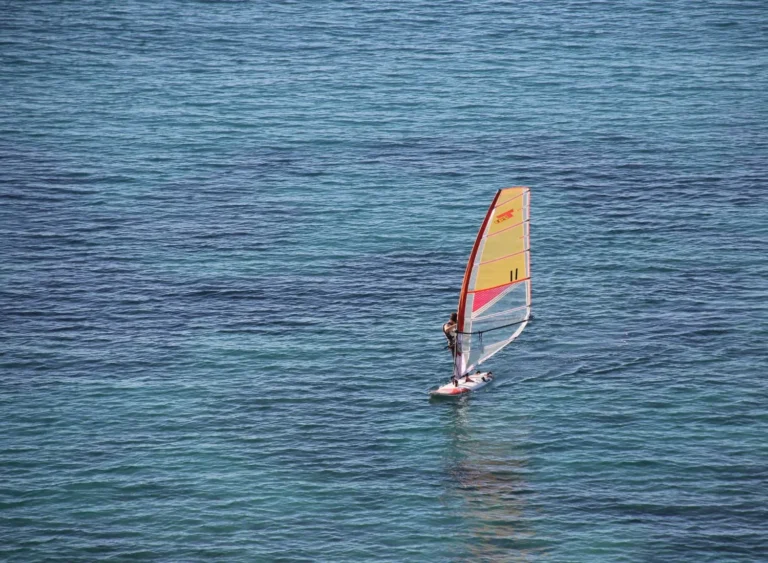
Season: mid-March → late November

Getting started with windsurfing in 2026: the guide

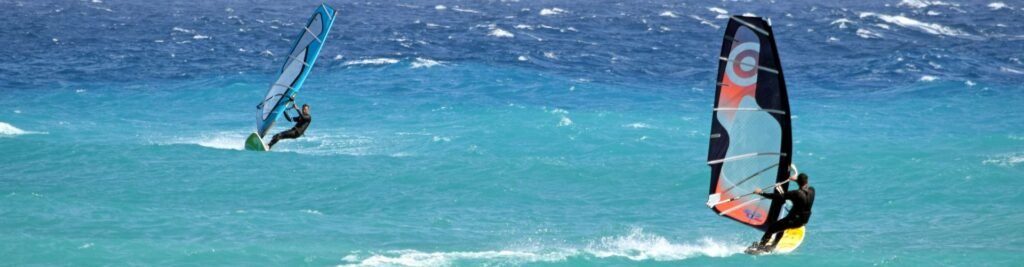
Suitable for all ages, windsurfing is a sport that can be practised at sea or on a lake, provided you can swim.
This guide covers the equipment, basic techniques, suitable spots and mistakes to avoid, so you can make rapid progress right from your very first sessions.
For ideal conditions, the lagoon in Sakalava Bay, Madagascar, offers a sailing season from mid-March to the end of November, with 98% of days suitable for sailing.
In summary:
- Windsurfing combines a board and an articulated rig. The only prerequisite is that you can swim.
- Beginners: a board of over 200 litres, a sail of 3 to 5 m² depending on your build.
- Ideal spot: a flat stretch of water, a side wind of force 2 to 3, and water shallow enough for you to stand.
- A sailing school helps you progress faster: 3 to 5 sessions are enough to master the basics.
- Key techniques: hoisting the sail, adopting the correct posture (arms outstretched, back straight, looking into the distance), sailing on a close-hauled course.
- Windsurfing is divided into freeride, freestyle and wave riding for continuous progression.
What is windsurfing?
Definition of windsurfing
Windsurfing is a water sport: standing on a board, the windsurfer is propelled by a sail attached to a hinged mast. An Olympic discipline since 1984, it is known interchangeably as ‘windsurfing’ or ‘sailboarding’ (source: World Sailing).
Unlike surfing, there is no need for waves: it is the wind that provides the power. The windsurfer’s body acts as a rudder by tilting the rig.
Windsurfing disciplines
|
Subject
|
Principle
|
Required level
|
At Ocean Lodge?
|
|---|---|---|---|
|
Freeride
|
Leisure riding on calm or choppy waters
|
Beginners to advanced learners
|
Yes
|
|
Freestyle
|
Acrobatic manoeuvres on calm water
|
Confirmed
|
Yes
|
|
Waves
|
Wave surfing with a sail
|
Expert
|
Yes (reef)
|
|
Slalom
|
Sprint races on a marked course
|
Confirmed
|
No
|
Why learn to windsurf?
Windsurfing has seen a resurgence in popularity since 2020, with equipment that is lighter than it was twenty years ago.
Physically, it’s a well-rounded sport: core strength, arms, shoulders and legs. Mentally, focusing on the wind and the sail allows you to truly switch off.
Schools welcome children from the age of 8. Adults can take up the sport at any age: today’s beginner’s equipment (wide boards, light sails) is designed so that people of all sizes can get out on the water from their very first session.
What equipment do you need to get started in windsurfing?
The wrong kit can turn a beginner’s experience into a real struggle. Here are the key points to bear in mind.
The float
Basic rule: the volume of the float (in litres) must be 100 litres greater than your weight.
- Simple calculation: your weight + 100 L
An adult weighing 75 kg would therefore start with a float of at least 175 litres, with a width of 75 to 80 cm and a retractable fin for stability.
The rig (sail + mast + wishbone)
|
Template
|
Recommended sail size
|
|---|---|
|
Child (under 40 kg)
|
2 to 3 m²
|
|
Teenager / small build
|
3 to 4 m²
|
|
Adult (60 to 80 kg)
|
4 to 5.5 m²
|
|
Heavyweight (over 85 kg)
|
5.5 to 6.5 m²
|
It’s best to start with a slightly undersized sail and increase the sail area as you improve.
Please note: if you don’t want to invest straight away, hiring windsurfing equipment is an excellent way to try it out before you buy.
Essential accessories
- Neoprene wetsuit: 3/2 mm in summer, 4/3 mm in cold water
- Buoyancy aid: compulsory for lessons, recommended for independent sailing
- Neoprene booties: protection against shellfish and the cold
- Halyard: rope for lifting the sail out of the water (supplied with complete rigs)
In Sakalava, the water temperature ranges between 23 and 28°C: a lycra top or shorty wetsuit is sufficient.
Where and how can I learn to windsurf?
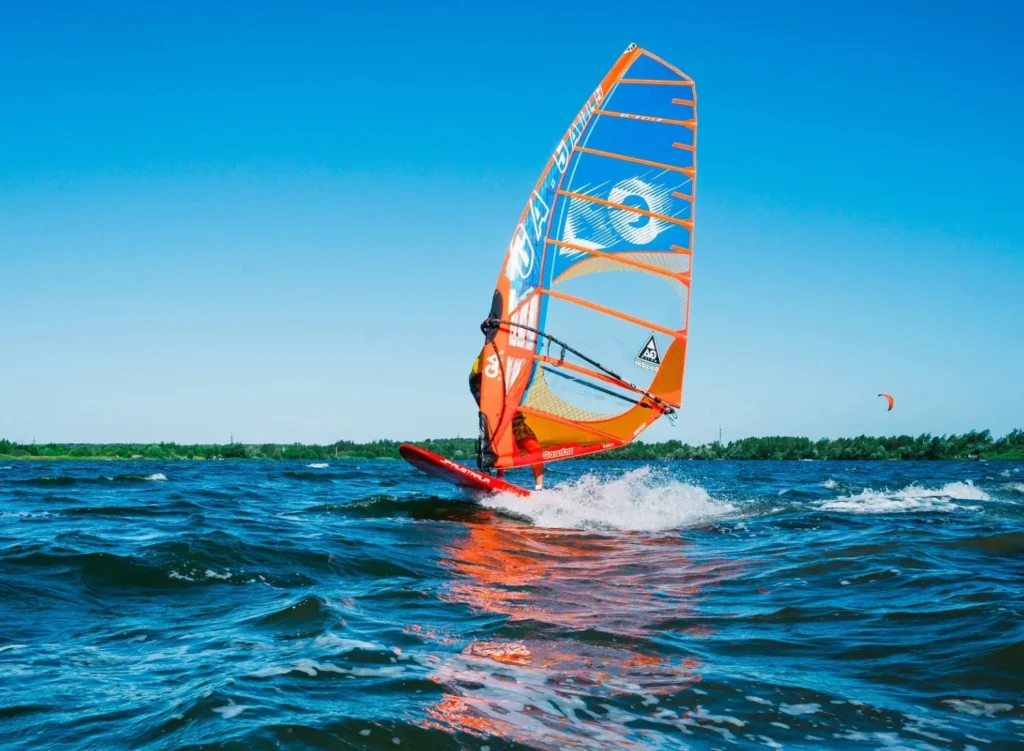
Choosing the right spot
A beginner’s spot meets three criteria:
- Flat water (lake, lagoon, sheltered bay),
- Shallow water (where you can touch the bottom)
- A steady wind of force 2 to 3 (8 to 15 km/h), ideally a sideshore wind.
To be avoided at all costs: an ‘offshore’ wind (blowing from land towards the open sea), which pushes beginners out to sea if they fall.
The best place to get started: Sakalava Bay
Located in the north of Madagascar, Sakalava Bay is undoubtedly one of the best spots in the world today for beginners to take up windsurfing.
There are many reasons for this:
- 98% of days are suitable for riding thanks to the Varatraza wind,
- A flat lagoon protected by the reef,
- A sandy seabed where you can stand,
- Side-to-side onshore wind.
The Varatraza blows at 15 to 35 knots depending on the time of year: during one-to-one lessons, the instructor adapts the equipment and the session to each pupil.
- The most comfortable times: around 3 hours before and after high tide.
- Ideal time to start: mid-March to June and October–November.
To find out more, read our article: When is the best time to go kitesurfing in Sakalava?
School or self-study?
A windsurfing school is still the quickest way to learn. An instructor immediately corrects your posture, helps you read the wind and ensures your safety.
At Ocean Lodge, for example, lessons are exclusively one-to-one: one instructor per student, Goya equipment (sails, masts and carbon wishbones), weekly hire once you’re independent, half-board or full-board stays, and a discount on the windsurfing component of the packages (for more information, see our prices).
Good to know: learning on your own is possible, but it takes longer. Without external feedback, bad habits can quickly set in. If you choose this route, make use of video tutorials and always sail with an experienced windsurfer within sight.
The ideal conditions for getting started
Wind force 2 to 3 (8 to 15 km/h), on a flat stretch of water with no waves or current.
|
Wind direction
|
Suitable for beginners?
|
|---|---|
|
Sideshore (parallel to the shore)
|
Yes, ideal: sailing along the coast, an easy return journey
|
|
Onshore (from the open sea towards the beach)
|
Acceptable: naturally drifts towards the edge
|
|
Offshore (from land out to sea)
|
No: pushes out to sea in the event of a fall
|
Check the wind forecast before each session: Windguru and Windy provide reliable, hourly updates.
The technical basics of windsurfing
Three fundamental skills to learn, in the correct order.
1. Take the sail out of the water
- Stand with your back to the wind, feet on either side of the mast foot, knees bent.
- Grab the sail-draining handle and pull gradually whilst straightening up using your legs (not your back).
- Let the water drain slowly from the sail. Avoid any sudden movements.
- Grab the wishbone with your front hand, keeping the mast perpendicular to the board.
Tip: position the board perpendicular to the wind before pulling. The wind will ‘lift’ the sail, making the effort easier.
2. Good posture
- Arms outstretched: use your body weight to counter the force of the wind, never the strength of your biceps
- Keep your back straight, with your upper body upright or leaning slightly backwards
- Look into the distance towards a point on the horizon, not at the board
- Feet shoulder-width apart, centred around the mast foot
3. Change direction
- Tacking (into the wind): tilt the rig backwards; the bow points upwind. Move round the front of the mast and grab the sail on the other side. This is the safest manoeuvre for a beginner.
- Gybing (downwind): tilt the rig forwards. The board turns away from the wind, and the sail swings from one side to the other.
How can I make rapid progress?
FFVoile proficiency levels
|
Level
|
Skills acquired
|
Estimated hours
|
|---|---|---|
|
1
|
Hoist the sail, sail close-hauled, tack
|
6 to 10 hours of practice
|
|
2
|
Sailing close-hauled, gybing, mastering the different points of sail
|
10 to 20 h
|
|
3
|
Harnesses, straps, planning
|
30 to 50 h
|
|
4
|
Waves, gliding jibe, water start
|
50 to 100 h
|
|
5
|
Advanced freestyle, competition
|
100 h +
|
Tips for speeding up
- Consistency: 2 to 3 short sessions a week are better than one 6-hour session on a Sunday
- Film yourself: spot posture flaws that aren’t obvious whilst sailing
- Vary the conditions: once you’re comfortable in light winds, gradually try sailing in stronger winds
- Join a community: forums, local groups
Common mistakes made by beginners
|
Type of error
|
Why is this a problem?
|
Solution
|
|---|---|---|
|
Arms bent
|
Exhaust your biceps in a matter of minutes
|
Keep your arms straight; use your body weight
|
|
Looking down at one’s feet
|
Causes the upper body to lose balance, leading to falls
|
Fix your gaze on a point on the horizon
|
|
Offshore wind
|
Drives you out to sea if you fall overboard
|
Always sail with a crosswind or an onshore wind
|
|
Sail too big
|
Uncontrollable as soon as the wind picks up
|
Start small, and gradually work your way up
|
|
Wanting the schedule too early
|
Repeated falls, frustration
|
First, master your posture and the orientation of the sail
|
The golden rule if you run into trouble: never get off your board to swim back. Wrap the sail around the mast, lie down on the board and paddle with your hands.
Windsurfing, wingfoiling or kitesurfing: which should you choose?
|
Criterion
|
Windsurfing
|
Kitesurfing
|
Wingfoil
|
|---|---|---|---|
|
Apprenticeship
|
Progressive, intuitive
|
Fast but demanding in terms of safety
|
Suitable for those with basic skiing skills
|
|
Minimum wind speed
|
12-15 km/h
|
15-20 km/h
|
10-15 km/h
|
|
Range
|
Total (no lines)
|
Long lines; clear space required
|
Total
|
|
Minimum age
|
None (you just need to be able to swim)
|
12 years old and 30 kg
|
Ages 8–9 on a stable board, without a foil
|
|
Budget for beginners
|
€800 to €1,500
|
€1,000 to €2,000
|
€1,200 to €2,500
|
|
At Ocean Lodge?
|
Lessons + hire
|
Lessons + hire
|
Lessons + hire
|
If you’re starting from scratch with water sports, windsurfing offers the most accessible learning curve. The skills you learn (reading the wind, handling the sail, balance) can be directly applied to kitesurfing or wingfoiling later on.
FAQ: Learning to windsurf
Which board should you choose if you’re new to windsurfing?
A float with a capacity of at least 175 litres, 75 to 80 cm wide, with a retractable fin for stability.
Is wingfoiling easier than windsurfing?
No. Windsurfing offers a more linear learning curve because your feet stay on the board right from the start. Wingfoiling involves manoeuvring the foil, which is more complex without prior experience.
At what age can you start windsurfing?
There is no minimum age for learning to windsurf. The only requirement is that you can swim.
What is the minimum wind speed required for windsurfing?
Around 12 to 15 km/h when windsurfing in the traditional way.
How long does it take to learn to windsurf?
3 to 5 two-hour sessions to cover the basics (hoisting the sail, sailing, tacking). The transition to a board and footstraps takes a further 20 to 50 hours.
Can you learn to windsurf in Madagascar?
Yes, it’s entirely possible to learn to windsurf in Madagascar at Ocean Lodge, situated opposite Sakalava Bay, an ideal spot for beginners.
Official sources
- World Sailing : Olympic status of windsurfing, international rules
- Windguru : detailed wind forecasts by location
Contact
Are you planning a windsurfing holiday in Madagascar?
Please email us with your dates and your level.

Thierry Surdez
Thierry, a Swiss national and founder of Ocean Lodge, is a Swiss federally certified instructor who has always been passionate about water sports. He enjoys sailing, windsurfing, kitesurfing and wingfoiling, and set up Ocean Lodge in 2018 with a simple idea: to offer well-organised, personalised and relaxed kitesurfing holidays in the exceptional setting of Sakalava Bay.